Guide
Trip switch keeps tripping? How to find the faulty circuit
A trip switch that keeps going off is doing its job: something on that circuit is leaking current to earth or drawing more than the circuit can carry. Switching everything off and bringing circuits and appliances back one at a time usually narrows it to a single appliance or a single circuit before anybody is called.
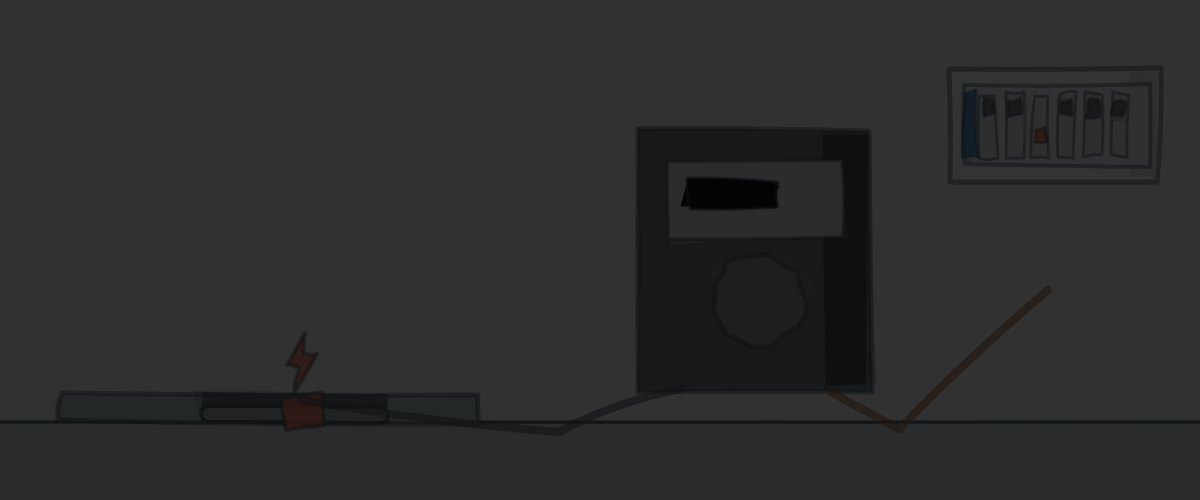
Which switch went off
Open the consumer unit cover and look for the switch that is down. Which one it is says a good deal about the fault.
| What tripped | What it reacts to | Common culprits |
|---|---|---|
| An RCD, with a test button | Current leaking to earth | A faulty appliance, damp, a damaged cable |
| One circuit breaker | Overload or a short circuit | Too many heaters on one circuit, a failed element |
| One RCBO | Either of the above, on one circuit | Anything on that circuit |
Then note when it trips. Immediately on reset points at a fault that is present all the time. After a few minutes or hours points at something that switches itself on, such as a fridge, an immersion heater or a dishwasher on a timer. Only in wet weather points outdoors.
The isolation routine
This is safe to do yourself and takes about half an hour of waiting. Stop and call an electrician instead if there is a burning smell, scorching, or water near anything electrical.
- Unplug everything on the affected circuits. Switching off at the socket is not enough for this test.
- Switch off every circuit breaker under the tripped RCD.
- Reset the RCD.
- Switch the breakers back on one at a time. If the RCD trips when one goes on, that circuit has the fault; leave it off.
- With the circuits back on, plug appliances in one at a time and leave each running for a few minutes.
- When it trips, the last thing plugged in is the prime suspect. Confirm by trying it again on its own.
If everything is back on and nothing trips, the fault may be intermittent. Write down what was running each time it tripped, because a pattern is the fastest clue anyone can be given.
The usual suspects
Appliances that heat water or use it are behind a large share of RCD trips: kettles, washing machines, dishwashers, immersion heaters and electric showers, where a failing element lets current leak to earth. Oven and grill elements do the same. Outdoor sockets, garden lights and outbuilding supplies that trip after rain usually have water in a connection. A trip that started the day after drilling, picture hanging or new flooring often means a fixing has gone through a cable.
An appliance that trips the RCD in one socket will trip it in any other socket on the same RCD, so trying it round the house gives the same result each time. Test it on its own instead, as in the routine above.
When the fault is in the wiring
If the RCD trips with nothing plugged in and one circuit switched on, the fault is in that circuit's cables, its fixed equipment or its accessories. Leave that circuit off and call an electrician, who will use an insulation resistance tester to find which section is leaking. That is not something to attempt with a screwdriver.
On a split load board there is also the case where no single item is faulty. Every appliance leaks a tiny current to earth, and a dozen of them on one RCD can add up to enough to trip it when one more switches on. The IET advises keeping standing leakage under 30% of the device's rating, and an electrician can measure it. The cure is spreading circuits across more RCDs or moving to RCBOs.
Things not to do
- Do not hold a trip switch up or tape it in place. It is the only thing between the fault and whoever touches it next.
- Do not replace a breaker with a higher rated one because it keeps tripping. The rating protects the cable, and a larger one lets the cable overheat.
- Do not keep resetting in the hope it stops. A fault that trips the RCD ten times will still be there on the eleventh.
- Do not fit a new consumer unit to cure it. A new RCD trips on the same fault.
When you call an electrician
Tell them which device trips, whether it trips at once or after a while, and what you have already ruled out. That can save the first hour. Fault finding is typically £60 to £110 for the first hour and £45 to £90 an hour after that. A broken ring circuit traced and repaired is usually £150 to £400, and out of hours call outs start at £80 to £160 for the first hour. In a rented home, report it to the landlord, whose job it is to have it fixed.
Common questions
Why does my RCD trip when it rains?
Water is getting into something outdoors: a socket, a light, a junction box or the supply to a shed. Switch off the circuit feeding the outside and see whether the trips stop, then have the connection found and sealed.
Why does it only trip at night?
Something is switching itself on: an immersion heater on an off peak timer, storage heaters, a dishwasher or washing machine on delay, or an electric car charging. Start with whatever runs on a timer.
Can an RCD be faulty itself?
It can, and an electrician tests it with an RCD tester to see whether it is tripping at the right current. It is rarely the cause, so rule out appliances and circuits first.
Is it safe to reset a tripped switch?
Once, yes, if there is no smell, heat or water. If it trips again straight away, leave it off and work through the isolation routine.