repairs
Electrical fault finding and repair
Fault finding is charged by the hour, £60 to £110, and most domestic faults are traced inside two. It is worth knowing that the cheapest half hour of that is the one you can do yourself, by unplugging everything on the offending circuit before anybody arrives.
What this covers
What it costs. Diagnosis is charged at £60 to £110 an hour with a minimum of one hour, and two thirds of domestic faults are traced within it. Full cost breakdown.
What the job covers
- Tracing an earth fault that trips an RCD
- Finding a break in a ring final circuit
- Diagnosing intermittent lighting faults
- Testing for borrowed neutrals between circuits
- Repairing damaged cable behind plaster or under floors
What is involved
A tripping circuit is telling you one of three things. A residual current device that trips is seeing current leaking to earth, and the usual culprits are a failing appliance element, water in an outside socket, or a nail through a cable. A circuit breaker that trips is seeing too much current, which is either overload or a short. And a device that trips at the same time every day is following something on a timer: an immersion heater, a heating control, a freezer defrost cycle.
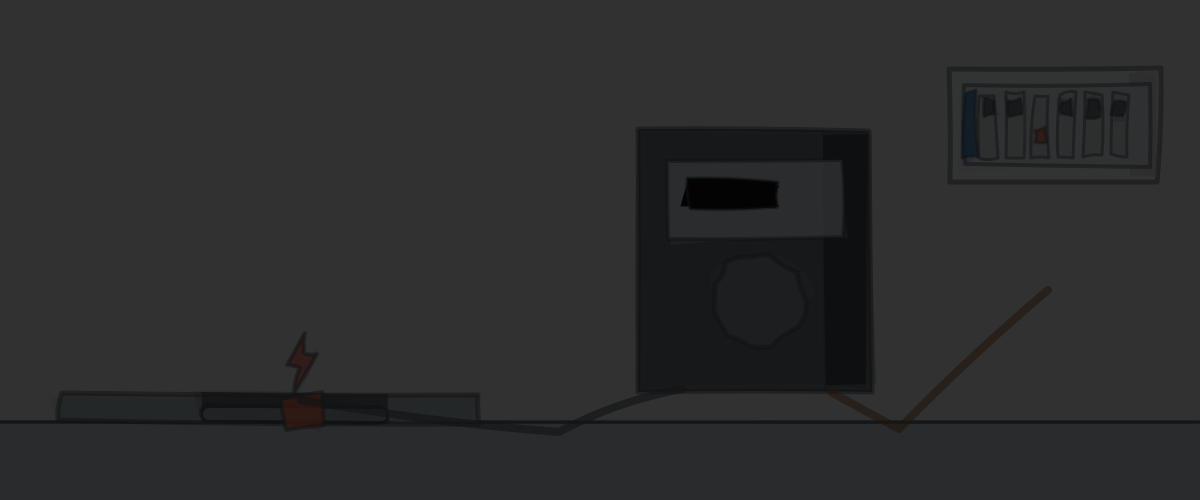
The half hour you can do free is the split test. Unplug everything on the circuit, reset it, and wait. If it holds, plug items back one at a time with a gap between each, and the fault will announce itself. If it trips with nothing connected, the fault is in the fixed wiring and that is where an electrician starts. Either way the person arriving has been handed the first half of the answer, and hourly work is the one kind of job where that shows up directly in the price.
Fixed wiring faults are found by dividing the circuit rather than by looking at it. The electrician disconnects the circuit at the board, measures insulation resistance, then splits the circuit at a mid point accessory and measures each half, and repeats until the fault sits between two known points. Intermittent faults are the expensive kind, because a fault that only appears when it rains or when a floor flexes cannot be measured on demand, and that is the case where a data logger left on the board for a week costs less than chasing it.
Choosing someone for the job
Ask for the hourly rate and the minimum charge, and ask what happens if the fault is found in ten minutes. Ask whether the rate includes the repair or only the diagnosis. Tell them what you have already eliminated, and when the fault happens, because a fault with a pattern is a different search from one without.
Common questions
My RCD trips every few days at no particular time.
That pattern usually points to moisture or a failing appliance element rather than to a wiring fault. Outside sockets, garden lighting, a shower, a washing machine and an immersion heater are the five to suspect, roughly in that order.
Half my sockets have stopped working.
On a ring final circuit a break in one leg can leave sockets apparently dead while others still work, and the circuit will not always trip. It needs testing rather than guessing, and it is one of the faults that is genuinely quick to find with the right instrument.