Guide
What is a consumer unit? What it does and when to replace
A consumer unit is the box, usually near the meter, that divides the incoming supply into circuits and holds the devices that switch each one off when something goes wrong. It is the modern fuse box, and replacing one is notifiable work in England and Wales that typically costs £450 to £900.
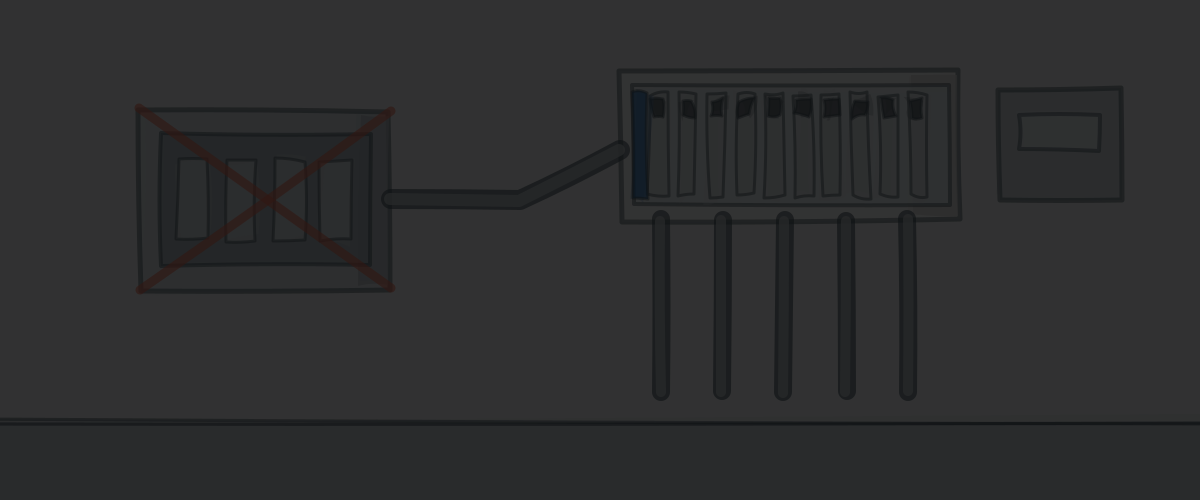
Fuse box, fuse board, consumer unit
They are the same thing under different names. The IET lists fuse box, fuse board and distribution board among the names used over the years. What has changed is what goes inside. A 1960s board could have a wooden back and rewireable fuses, short lengths of wire that melt when too much current flows and have to be rethreaded by hand. A modern consumer unit uses circuit breakers that switch off and can be reset, and RCDs that guard against electric shock. Between the two came boards with cartridge fuses, which are swapped rather than rewired and are safer than bare wire, but still give no protection against shock unless an RCD has been added.
NICEIC's advice to householders is direct: if your home still has a fuse box, have it replaced with a modern consumer unit.
What is inside a modern unit
- Main switch. Turns off the whole installation. It isolates and gives no protection of its own, which makes it the switch to use in an emergency.
- Circuit breakers. One per circuit, rated in amps: one for the cooker, one for the shower, one or two for sockets, one or two for lights. They trip on overload or a short circuit.
- RCDs or RCBOs. Rated in milliamps, they switch off when current leaks to earth. On many boards two RCDs each cover a group of circuits; on newer ones an RCBO covers each circuit on its own.
- Surge protection. A device that limits voltage spikes, now required in most new installations.
- Arc fault detection. Recommended by the current wiring regulations, and still optional in homes.
The meter and the sealed main fuse next to it are not part of the consumer unit. The meter is your energy supplier's responsibility and the main fuse the network operator's, and neither is anything an electrician working for you should open.
Why new units have been metal since 2016
From 1 January 2016 the IET Wiring Regulations required consumer units in homes to be made of non-combustible material, which in practice means steel. The rule followed reports from fire investigators of a rising number of fires involving plastic consumer units, often starting at a loose connection. The IET's concern is a board burning on an escape route, in the hallway or under the stairs, and releasing toxic smoke.
The rule applies to new installations. The IET is clear that existing plastic units do not all have to be replaced, and that the sensible step is an inspection of the installation by a competent person.
Signs a consumer unit is due for replacement
No single symptom means a board must go, but these are the ones that make an electrician recommend it:
- rewireable fuses, or a wooden backboard
- no RCD protection on socket or lighting circuits
- scorch marks, a smell of hot plastic, crackling, or a cover that is warm
- no spare ways for a new circuit such as an EV charger, a shower or a garden supply
- gaps in the enclosure big enough to put a finger through, which the IET says is unlikely to be safe
- an inspection report recommending replacement
A report on the whole installation before committing is money well spent, because a board change on circuits with hidden faults turns into a longer and more expensive day.
What a replacement involves
Replacing a consumer unit is notifiable work under Part P in England and Wales. A registered electrician notifies it through their scheme and you receive an Electrical Installation Certificate on the day and a building regulations compliance certificate by post afterwards. Scotland and Northern Ireland run their own systems.
Expect the power to be off for most of a working day. The board itself is quick; testing every circuit before it is connected to the new protection is what takes time, and it is also where pre-existing faults come to light. A circuit that leaks current to earth will trip a new RCD immediately, and has to be repaired before it can go back on.
| Job | Typical price |
|---|---|
| Up to 10 circuits, split load board | £450 to £650 |
| Up to 10 circuits, RCBO on each | £550 to £800 |
| 12 to 16 circuits, RCBO on each | £700 to £1,100 |
| Earthing and bonding brought up to standard | £150 to £400 |
When comparing quotes, check whether each includes surge protection, an RCBO on every circuit or a split load design, and an allowance for earthing and bonding. Those lines explain most of the gap between two prices for the same house.
Common questions
Do plastic consumer units need replacing?
Not automatically. The metal rule applies to boards fitted from 2016. A plastic board in good condition with RCD protection can stay; one that shows heat damage or sits on an escape route is worth discussing with an inspector.
Can I replace a consumer unit myself?
Not without notifying building control before you start in England or Wales, and the testing needs instruments and training most householders do not have. In practice this is a job for a registered electrician.
Can a consumer unit be moved?
Yes, but every circuit has to be extended to reach the new position, which makes it a bigger job. A relocation is typically £900 to £1,600.
How do I label my consumer unit?
Switch off one breaker at a time and note what stops working. An electrician fitting a new board should leave a circuit chart beside it.
Where to go from here
- Fuse box replacementFuse box replacement costEarthing and bondingEarthing and bonding costEICREICR cost